Euro Emissions Standards Explained
Euro emissions standards are rules that limit how much pollution a vehicle is allowed to produce. They set maximum limits for exhaust pollutants such as nitrogen oxides (NOx), carbon monoxide (CO), hydrocarbons (HC) and fine particles (PM and particle number). The higher the Euro number, the stricter the limits and, in general, the cleaner the vehicle is meant to be on the road. London’s ULEZ is built around these limits: petrol vehicles usually need to meet at least Euro 4 for NOx, and diesel vehicles usually need to meet Euro 6 for NOx and particulates.
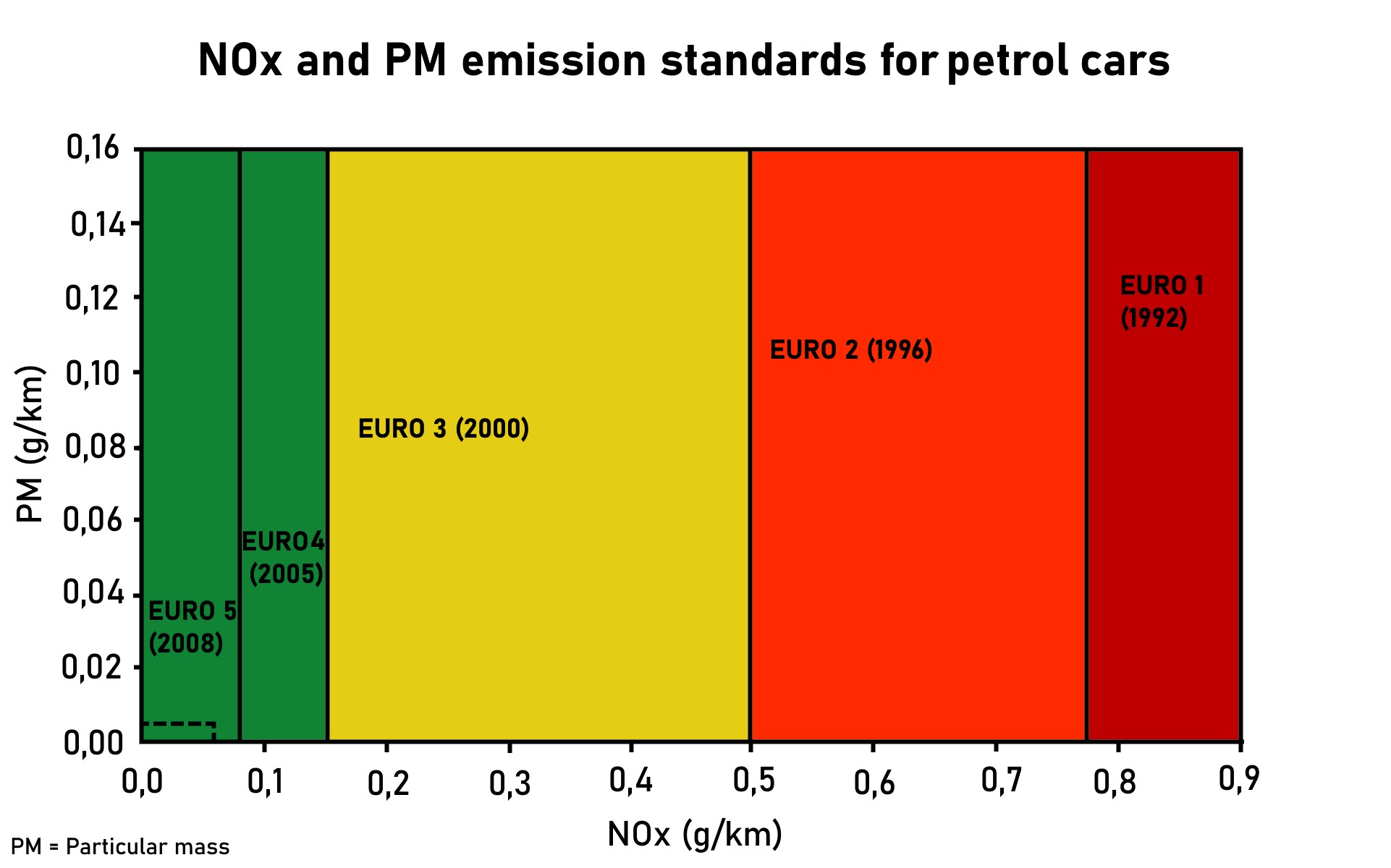
Figure 1: NOx and PM emission standards for petrol cars.
What are Euro standards?
Euro standards are EU-wide (and now retained UK) emissions rules that apply to new vehicles sold in Europe and the UK. For each standard – Euro 1, Euro 2, Euro 3 and so on – there is a set of numerical limits for pollutants such as NOx, CO, HC, particulate mass (PM) and, more recently, particle number (PN). When a car is type-approved, it has to show in laboratory and on-road tests that its emissions stay below these limits for a defined part of its lifetime.
The early stages, Euro 1 to Euro 3, introduced basic controls that removed the very highest emitting vehicles from the market but still allowed relatively high pollution compared with modern standards. Euro 4 and Euro 5 then tightened the limits, particularly for petrol cars and for particulate emissions from diesel engines. Euro 6, which underpins most current policies, is much stricter again for diesel NOx and PM, and is combined with “real driving emissions” testing on the road to reduce the gap between lab results and real-world performance.
When people talk about a “Euro 4 petrol” or “Euro 6 diesel”, they are referring to these official emissions thresholds. ULEZ and Clean Air Zones use them as a simple way to group vehicles into those that are expected to be relatively clean and those that are more polluting.
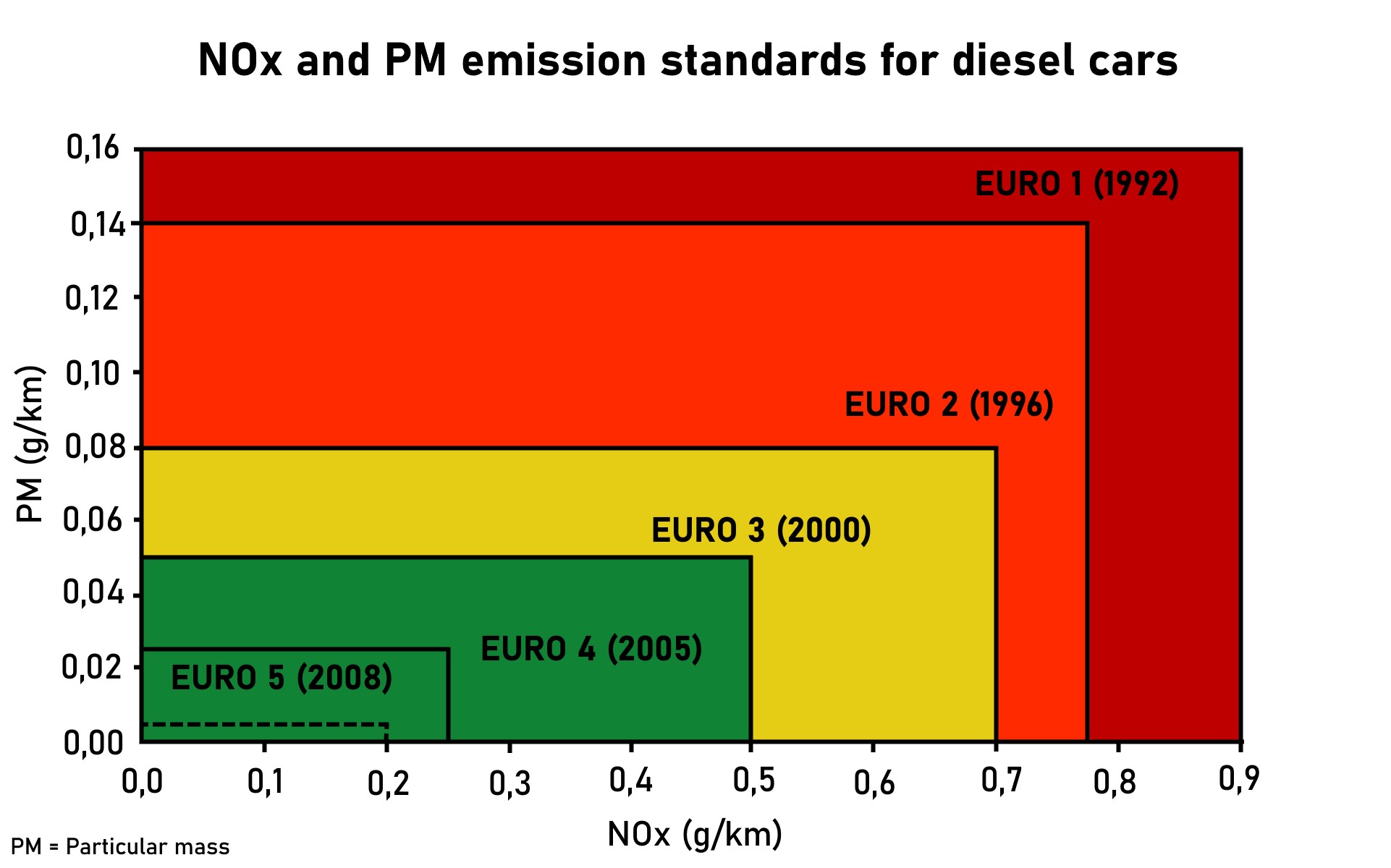
Figure 2: Nox and PM emission standard for diesel cars.
Rough timeline by Euro standard
Euro standards apply to new vehicles from specific dates, but older models can continue to be used for many years. That means the age of your car is only a guide to its standard. As a simple rule of thumb for passenger cars, Euro 3 typically covers vehicles first registered from around 2000 to 2005, Euro 4 from about 2005 to 2009, Euro 5 from roughly 2009 to 2014, and Euro 6 from 2014 onwards. Some models switched early, others late, and imported vehicles may not follow the UK pattern, so the first registration year is an estimate, not a guarantee of the Euro level.
The exact Euro standard for a vehicle is recorded in the type-approval paperwork and, for newer cars, in the manufacturer’s documentation. That is why official tools and ULEZ checkers do not rely purely on the age of the vehicle, but instead look up registration and type-approval data against the DVLA and manufacturer records wherever possible.
Why petrol and diesel are treated differently
Petrol and diesel engines produce different patterns of pollution. Historically, petrol engines have tended to emit lower levels of NOx but higher CO and hydrocarbon emissions, while diesel engines have been more fuel-efficient and therefore lower in CO₂, but much worse for NOx and particulates. As a result, Euro standards set different numerical limits for petrol and diesel, and policy schemes such as ULEZ set different cut-off points for compliance.
For London’s ULEZ, petrol cars and vans are normally considered compliant from Euro 4 onwards, because Euro 4 tightens NOx limits enough to make a clear difference at the roadside. Diesel cars and vans usually have to meet Euro 6 to be compliant, because earlier diesel standards allowed much higher NOx emissions and many vehicles were found to emit more on the road than in the lab. This is why modern clean air policies focus so heavily on older diesel vehicles: they combine high real-world NOx and PM emissions with long urban mileages.
Importantly, Euro standards are based on measured emissions, not engine size. A newer 3.0-litre Euro 6 petrol or diesel engine can, in emissions terms, be much cleaner than an older 1.2-litre Euro 3 or Euro 4 engine if the newer engine meets tighter NOx and PM limits and uses more advanced after-treatment systems.
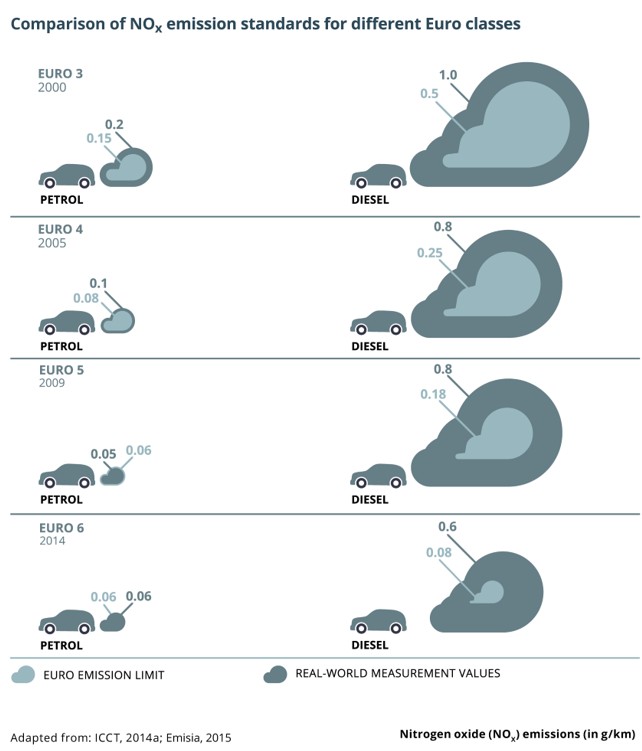
Figure 3: NOx emissions of Diesel cars
How Euro standards link to ULEZ
London’s ULEZ uses Euro standards as a practical way to decide which vehicles can drive in the zone without paying a charge. In simple terms, the scheme looks at whether a vehicle’s type-approval meets at least Euro 4 for petrol or Euro 6 for diesel, as well as treating electric vehicles as zero-emission. Vehicles that meet these thresholds are considered compliant and do not pay the daily charge; vehicles that do not meet them are normally subject to the ULEZ fee when used inside the zone.
Because Euro standards are about exhaust emissions, not about how big or powerful the engine is, some relatively large, modern engines can still qualify as ULEZ compliant if they meet the required NOx and PM limits. By contrast, many older small petrol and diesel cars fail ULEZ because they were designed under looser Euro limits and emit more pollution per kilometre, even though their engines look small on paper.
Electric vehicles are treated as zero-emission at the tailpipe and do not pay ULEZ. Plug-in hybrids and conventional hybrids are judged by the same Euro standards as other cars; a hybrid that meets Euro 6 diesel or Euro 4 petrol requirements may be compliant, while an older hybrid may not.
| Area / metric | Latest figure | Notes |
|---|---|---|
| United Kingdom – total licensed vehicles | 41.7 million vehicles (end of 2024) | All road-using vehicles combined (cars, vans, HGVs, buses, etc.). |
| United Kingdom – licensed zero-emission vehicles | 1.394 million vehicles (3.4% of all vehicles) | Includes battery electric and other zero-emission vehicles. |
| London – share of vehicles seen that are ULEZ compliant | Approximately 96–97% of vehicles | Based on vehicles observed driving in the London-wide ULEZ on a typical day. |
| London – trend in ULEZ compliance | Up from around 39% in early 2017 | Shows rapid shift from older, higher-emitting vehicles to cleaner, ULEZ-compliant ones. |
There is no single official UK-wide statistic labelled “ULEZ-compliant cars”, because ULEZ is a London scheme. However, national licensing data show how quickly the vehicle fleet is changing, and London figures show that the vast majority of vehicles now meet ULEZ-equivalent standards in practice.
Why some vehicles don’t show a Euro standard
Not every older vehicle has its Euro standard clearly recorded in the DVLA database. This is especially common for cars first registered around the early 2000s, when Euro 3 and Euro 4 overlapped, and for vehicles that were imported or converted after their original registration. In these cases, the V5C logbook may not list a specific Euro level at all.
When the Euro standard is missing, online tools often have to estimate it from the vehicle’s age, fuel type and sometimes engine code. That estimate is usually good enough to give a rough idea, but ULEZ decisions are ultimately based on the official data held by TfL and DVLA. If those records say a vehicle does not meet the required standard, it may still be charged even if a third-party checker suggests that it might be compliant.
This is why tools like the ULEZ car check on this site clearly flag when a Euro rating is only an approximation and always emphasise that the official TfL checker is the final authority for charges and fines.
What Euro standard is my car?
The most reliable way to find out how your vehicle will be treated for ULEZ is to use the official TfL vehicle checker and enter your registration. This looks up DVLA and type-approval data and gives a simple “pay” or “don’t pay” answer based on the current rules.
You can also look at your vehicle’s documentation. Many manufacturers list the Euro emissions standard in the owner’s manual, on their website, or on the certificate of conformity. For newer vehicles this is usually straightforward; for older cars and imports it can be more patchy.
Finally, tools like the ULEZ car check on this site use government-sourced registration data together with typical timelines to estimate the Euro standard from the vehicle’s age and fuel type. If different sources disagree, always treat the TfL result as the one that matters for ULEZ charges and penalties.
What about Euro 7?
The next step in the series, Euro 7, is a new emissions standard agreed by the European Union in 2024. It is intended to further reduce air pollutant emissions from exhaust fumes, tighten control of brake and tyre particle emissions, and introduce minimum durability rules for batteries in electrified vehicles. Euro 7 keeps broadly similar tailpipe limits to the latest version of Euro 6, but extends how long vehicles must stay within those limits and brings in stricter checks on real-world performance and non-exhaust sources.
Under the EU Regulation, Euro 7 starts to apply to new types of light-duty vehicles (cars and vans) from late 2026 and to all new light-duty vehicles from late 2027. In Great Britain, the Department for Transport and the Vehicle Certification Agency are consulting on how far to follow Euro 7, but the Regulation will automatically apply in Northern Ireland because of existing arrangements. Whatever the final details, the general direction is towards vehicles that remain cleaner for longer in real driving, rather than just at the point of sale.
For drivers thinking about future-proofing their car against stricter clean air rules, a newer petrol or diesel that already meets the latest Euro 6 versions, or a battery electric vehicle, is likely to be more resilient than an older Euro 4 or Euro 5 model. As Euro 7 and similar standards are phased in, the gap in emissions and potential policy treatment between older and newer vehicles is expected to grow.
Quick summary
Euro standards are pollutant limits for vehicles, not a measure of engine size or power. Higher Euro numbers generally mean tighter limits on NOx, PM and other emissions, so a modern 3.0-litre Euro 6 car can be cleaner at the tailpipe than an older 1.2-litre Euro 3 or Euro 4 car. London’s ULEZ uses these standards to decide who pays: most petrol vehicles need to be at least Euro 4, most diesel vehicles need to be Euro 6, and electric vehicles do not pay at all. National statistics show a rapidly changing vehicle fleet and London data show that almost all vehicles now seen in the capital already meet ULEZ-equivalent standards.
Check your vehicle and fuel costs
If you are unsure which Euro standard your car meets or whether it is likely to be ULEZ compliant, it is worth checking before you travel. You can also look at fuel economy and running costs to decide whether upgrading to a newer, cleaner vehicle might save money in the long run as standards tighten.
References (Harvard style)
- Department for Transport (DfT) (2025) Vehicle licensing statistics: 2024. GOV.UK. Available at: https://www.gov.uk/government/statistics/vehicle-licensing-statistics-2024 (Accessed 11 December 2025).
- Department for Transport (DfT) (2025) Vehicle licensing statistics, United Kingdom: 2024. GOV.UK. Available at: https://www.gov.uk/government/statistics/vehicle-licensing-statistics-2024/vehicle-licensing-statistics-united-kingdom-2024 (Accessed 11 December 2025).
- Transport for London and Greater London Authority (2024) London-wide Ultra Low Emission Zone – One Year Report. London: TfL/GLA.
- Vehicle Certification Agency (2025) Light-duty emissions approvals for GB type approval. GOV.UK. Available at: https://www.vehicle-certification-agency.gov.uk (Accessed 11 December 2025).
- European Commission (2022) Commission proposes new Euro 7 standards to reduce pollutant emissions from vehicles. Brussels: European Commission.
- European Union (2024) Regulation (EU) 2024/1257 on type-approval of motor vehicles and engines with respect to their emissions and battery durability (Euro 7). Official Journal of the European Union, L, 8 May.